



Sterling vs. Quanta: Which Infrastructure Stock Wins Today?



The U.S. infrastructure services space is entering a multi-year expansion phase, supported by rising investments in power, data centers, manufacturing and transportation networks. Within this landscape, Sterling Infrastructure, Inc. STRL and Quanta Services, Inc. PWR have emerged as two high-quality operators benefiting from secular tailwinds tied to electrification, digital infrastructure and large-scale project execution.
Sterling has repositioned itself toward higher-margin, mission-critical end markets such as data centers and advanced manufacturing, while steadily improving profitability and backlog visibility. Quanta, on the other hand, operates at a much larger scale and sits at the center of utility modernization, energy transition and grid expansion, leveraging its diversified, solutions-based platform.
Both companies are executing well, delivering strong earnings growth and expanding backlogs. However, differences in scale, valuation, growth visibility and execution strategy make this comparison timely for investors evaluating infrastructure exposure today. Let’s dive deep and closely compare the fundamentals of the two stocks to determine which one is a better investment now.
The Case for Sterling Stock
Sterling has built a compelling growth story by shifting its portfolio toward higher-margin, mission-critical projects. The company’s E-Infrastructure segment—focused on data centers, semiconductors and advanced manufacturing—has become the primary growth engine, delivering triple-digit revenue growth in the latest quarter and benefiting from strong demand trends.
The strategic pivot toward complex, large-scale projects is translating into superior profitability. Sterling delivered adjusted EBITDA margin above 20% for the first time in 2025, supported by disciplined project selection and execution efficiency. This margin profile sets it apart from many mid-cap infrastructure peers and reflects a structurally improved business mix.
Backlog visibility remains a key strength. Sterling exited 2025 with a signed backlog of approximately $3 billion, up 78% year over year, with total opportunity visibility nearing $4.5 billion when including unsigned awards and pipeline projects. This provides strong revenue visibility for 2026 and underpins management’s guidance for mid-20% growth in both revenues and earnings.
Another positive is Sterling’s operational discipline and capital allocation. The company has demonstrated consistent earnings growth, with adjusted EPS rising more than 50% in 2025 and maintaining a multi-year track record of strong expansion. Its ability to generate strong operating cash flow further enhances flexibility for reinvestment and shareholder returns.
However, Sterling is not without risks. Its smaller scale compared to Quanta makes it more sensitive to project-level execution and end-market concentration. While the pivot to mission-critical work has improved margins, it also increases reliance on data center and industrial capex cycles. Additionally, weakness in its Building Solutions segment—linked to residential softness—remains a near-term headwind.
Overall, Sterling stands out as a high-growth, margin-expansion story with strong execution, but with relatively higher sensitivity to cyclical swings compared to larger peers.
The Case for Quanta Stock
Quanta represents a fundamentally different investment profile, defined by scale, diversification and long-cycle infrastructure exposure. The company operates at the center of utility modernization, power generation, grid resilience and energy transition—areas expected to see sustained investment over the next decade.
The company’s financial performance reflects this positioning. Quanta delivered record revenues, earnings and backlog in 2025, with revenues reaching $28.5 billion and adjusted EPS growing 20% year over year. This consistent growth track record—spanning nearly a decade—highlights its ability to compound earnings across cycles.
Backlog is a major differentiator. Quanta ended 2025 with a record backlog of approximately $44 billion, providing multi-year revenue visibility that few peers can match. This scale offers resilience against short-term macro volatility and supports sustained growth expectations.
The company’s diversified platform is another key strength. Its exposure spans electric infrastructure, underground utilities and large-scale industrial projects, enabling it to benefit from multiple secular trends simultaneously. Management highlighted strong demand driven by electrification, data center power needs and grid expansion, reinforcing a long runway for growth.
Strategic acquisitions and investments further enhance Quanta’s positioning. The company continues to expand its capabilities through bolt-on acquisitions and supply chain investments, including significant capital deployment toward transformer manufacturing and vertical integration. These initiatives strengthen its competitive moat and execution certainty.
That said, Quanta’s scale comes with trade-offs. Its margins are structurally lower than Sterling’s, reflecting the nature of large utility and infrastructure projects. The business is also exposed to regulatory, permitting and macroeconomic risks that can impact project timing and execution.
Additionally, the stock trades at a premium valuation, which may limit near-term upside despite strong fundamentals.
Momentum Check: Who Is Leading the Rally?
Both stocks have delivered strong share price performance, significantly outperforming broader markets and sector benchmarks. Sterling has gained 54.1% year to date, slightly ahead of Quanta’s 49.5% rise. This compares favorably with the Zacks Engineering – R&D Services industry’s 33.8% gain and the broader Zacks Construction sector’s 14.4% increase.
Sterling’s outperformance reflects investor enthusiasm around its high-growth, high-margin transformation, while Quanta’s rally is driven by its exposure to long-duration infrastructure themes and consistent execution.
STRL vs PWR Price Performance (YTD)

Image Source: Zacks Investment Research
Valuation Snapshot: Growth vs. Premium Pricing
Valuation highlights a clear divergence between the two stocks. Sterling trades at a forward 12-month P/E of 32.58X, while Quanta commands a significantly higher multiple of 45.57X. Both stocks trade at a premium to the Zacks Construction sector average of 21.72X and the broader market.
The premium for Quanta reflects its scale, backlog visibility and long-term growth profile. However, Sterling’s lower multiple relative to Quanta suggests a more attractive risk-reward balance, especially given its faster expected growth rate.
STRL vs PWR Valuation – P/E F12M

Image Source: Zacks Investment Research
Estimate Revisions: Tracking Earnings Momentum
Earnings estimate trends remain positive for both companies, signaling continued analyst confidence. Sterling’s 2026 EPS estimate has moved up to $13.76, implying growth of 26.5% year over year, alongside expected revenue growth of 25.6%.
STRL Estimate

Image Source: Zacks Investment Research
Quanta’s 2026 EPS estimate has also inched higher to $13.11, reflecting 22% expected growth and revenue expansion of 17.2%.
While both companies show strong earnings momentum, Sterling’s higher growth rate provides a relative edge in near-term earnings acceleration.
PWR Estimate
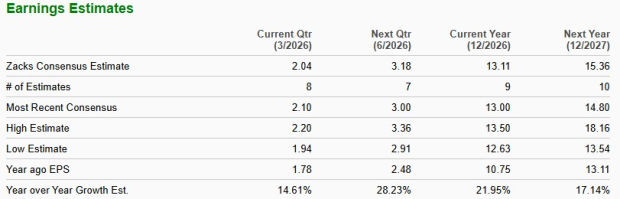
Image Source: Zacks Investment Research
Final Take: Which Stock Wins Today?
Sterling and Quanta both offer compelling exposure to the infrastructure supercycle, but they cater to different investor preferences.
Quanta stands out as a large-cap compounder with unmatched scale, diversification and backlog visibility. Its positioning in electrification, grid modernization and energy infrastructure provides durable, long-term growth with lower execution risk.
Sterling, however, offers a more attractive combination of faster growth, expanding margins and relatively lower valuation. Its strategic focus on mission-critical infrastructure and strong backlog growth positions it for continued earnings outperformance, albeit with slightly higher cyclicality.
Considering the current setup, Sterling appears to hold better upside potential. The stock’s stronger earnings growth trajectory, improving margin profile and more reasonable valuation provide a favorable risk-reward balance. This view is further supported by its Zacks Rank #1 (Strong Buy), compared with Quanta’s Zacks Rank #3 (Hold), indicating stronger near-term momentum and analyst conviction. You can see the complete list of today’s Zacks #1 Rank stocks here.
For investors seeking steady, long-term compounding, Quanta remains a high-quality choice. However, for those prioritizing growth and upside potential at current levels, Sterling looks better positioned to win today.
7 Best Stocks for the Next 30 Days
Just released: Experts distill 7 elite stocks from the current list of 220 Zacks Rank #1 Strong Buys. They deem these tickers "Most Likely for Early Price Pops."
Since 1988, the full list has beaten the market more than 2X over with an average gain of +23.9% per year. So be sure to give these hand picked 7 your immediate attention.
See them now >>Want the latest recommendations from Zacks Investment Research? Today, you can download 7 Best Stocks for the Next 30 Days. Click to get this free report
Quanta Services, Inc. (PWR): Free Stock Analysis Report
Sterling Infrastructure, Inc. (STRL): Free Stock Analysis Report
This article originally published on Zacks Investment Research (zacks.com).
Source Zacks-com


