



Pfizer's Cancer Drugs Deliver Growth Amid Competitive Pressure



Pfizer PFE is one of the largest and most successful drugmakers in oncology. It boasts a strong portfolio of approved cancer medicines as well as a robust pipeline of cancer candidates with a focus on multiple modalities, including small molecules, antibody-drug conjugates (ADCs) and immuno-oncology biologics.
The addition of Seagen in 2023 strengthened its position in oncology by adding four ADCs — Adcetris, Padcev, Tukysa and Tivdak. The acquired Seagen products contributed meaningfully to Pfizer’s revenues in 2024 and so far in 2025. Seagen also has some next-generation ADC candidates in its pipeline.
Oncology sales comprise around 28% of its total revenues. Its oncology revenues grew 7% year to date, driven by drugs like Xtandi, Lorbrena, the Braftovi-Mektovi combination and Padcev, which made up for declining sales of drugs like Ibrance.
Xtandi recorded alliance revenues of $578 million in the quarter, up 3% year over year. Inlyta revenues were $226 million in the quarter, down 9%. Lorbrena sales rose 28% to $268 million. Braftovi/Mektovi revenues were $202 million, up 17% year over year. New drug, Elrexfio, generated sales of $85 million in the third quarter, same as in the previous quarter. Ibrance revenues declined 5% year over year to $1.06 billion
Among the ADCs added from the 2023 acquisition of Seagen, Adcetris sales of $215 million declined 20% year over year due to competitive pressure in the United States. Padcev rose 13% to $464 million, driven by strong demand trends mainly due to market share gains in first-line metastatic urothelial cancer.
Pfizer has ventured into the oncology biosimilars space and markets six biosimilars for cancer. Revenues from oncology biosimilars were $315 million, up 10% year over year.
Pfizer also advanced its oncology clinical pipeline with several candidates entering late-stage development, like atirmociclib and sigvotatug vedotin. Regulatory applications seeking approval of sasanlimab and vepdegestrant are under review in the United States. By 2030, it expects to have eight or more blockbuster oncology medicines in its portfolio.
In July, it closed a global ex-China in-licensing agreement with China's 3SBio for exclusive rights to the latter’s dual PD-1 and VEGF inhibitor, which will strengthen its oncology pipeline.
Pfizer is also working on expanding the labels of approved oncology drugs like Padcev, Adcetris and Elrexfio, among others.
With solid contributions from key cancer medicines and continued pipeline progress, Pfizer’s oncology strategy remains a central driver of its long-term outlook.
Competition in the Oncology Space
Other large players in the oncology space are AstraZeneca AZN, Merck MRK and Bristol-Myers BMY.
For AstraZeneca, oncology sales now comprise around 43% of total revenues. Sales in its oncology segment rose 16% in the first nine months of 2025. AstraZeneca’s strong oncology performance was driven by medicines such as Tagrisso, Lynparza, Imfinzi, Calquence and Enhertu (in partnership with Daiichi Sankyo).
Merck’s key oncology medicines are PD-LI inhibitor, Keytruda and PARP inhibitor, Lynparza, which it markets in partnership with AstraZeneca. Keytruda, approved for several types of cancer, alone accounts for more than 50% of Merck’s pharmaceutical sales. Keytruda recorded sales of $23.3 billion in the first nine months of 2025, up 8% year over year.
Bristol-Myers’ key cancer drug is PD-LI inhibitor, Opdivo, which accounts for around 20% of its total revenues. Opdivo’s sales rose 8% to $7.54 billion in the first nine months of 2025.
PFE’s Stock Price, Estimates & Valuation
Pfizer’s stock has declined 4.7% so far this year against an increase of 17.8% for the industry.
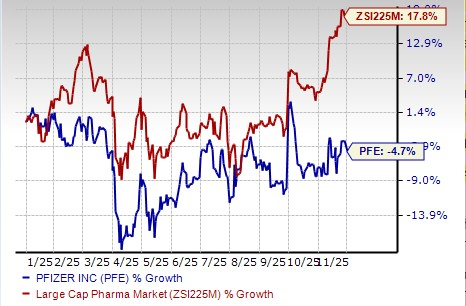 Image Source: Zacks Investment Research
From a valuation standpoint, Pfizer appears attractive relative to the industry and is trading below its 5-year mean. Going by the price/earnings ratio, the company’s shares currently trade at 8.02 forward earnings, lower than 17.26 for the industry and the stock’s 5-year mean of 10.44.
 Image Source: Zacks Investment Research
The Zacks Consensus Estimate for 2025 earnings has risen from $3.06 per share to $3.14, while that for 2026 has increased from $3.14 per share to $3.15 over the past 30 days.
 Image Source: Zacks Investment Research
Pfizer currently has a Zacks Rank #3 (Hold). You can see the complete list of today’s Zacks #1 Rank (Strong Buy) stocks here.
Zacks' Research Chief Names "Stock Most Likely to Double"
Our team of experts has just released the 5 stocks with the greatest probability of gaining +100% or more in the coming months. Of those 5, Director of Research Sheraz Mian highlights the one stock set to climb highest.
This top pick is a little-known satellite-based communications firm. Space is projected to become a trillion dollar industry, and this company's customer base is growing fast. Analysts have forecasted a major revenue breakout in 2025. Of course, all our elite picks aren't winners but this one could far surpass earlier Zacks' Stocks Set to Double like Hims & Hers Health, which shot up +209%.
Free: See Our Top Stock And 4 Runners UpWant the latest recommendations from Zacks Investment Research? Today, you can download 7 Best Stocks for the Next 30 Days. Click to get this free report
AstraZeneca PLC (AZN): Free Stock Analysis Report
Bristol Myers Squibb Company (BMY): Free Stock Analysis Report
Pfizer Inc. (PFE): Free Stock Analysis Report
Merck & Co., Inc. (MRK): Free Stock Analysis Report
This article originally published on Zacks Investment Research (zacks.com).
Source Zacks-com


