



3 Small Caps for Income Investors



Some investors prefer access to investment income through instruments like CD’s or money market/dividend ETF’s, a “set it and forget it” mentality. But others prefer the dividend income of individual companies which also offer appreciation upside of the underlying security as well as typically higher yields, thus potentially resulting in higher “total return”, but with greater risk.
Here we profile 3 small caps offering dividends which are ideal case studies in how to think about dividends and dividend risk, and hopefully a bit of a primer showcasing the nuances of dividends.
CBL & Associates Properties, Inc. (CBL) is a self-managed, integrated real estate investment trust (REIT) focused on the ownership, development, acquisition, leasing, management and operation of regional shopping malls and other commercial properties.
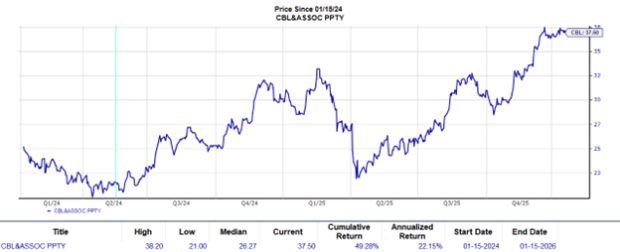
Image Source: Zacks Investment Research
And while malls and potential “dark” spaces may scare some investors, the “repurposing” adaptability of real estate players is often underappreciated, as they can readily adjust to the times. Think pickleball courts, fitness clubs, and urgent healthcare.
Its forward dividend yield of 4.5% is not bad, but might seem pedestrian to some investors who’d argue I can get that with a CD or an income-focused ETF. But what lies beneath the surface is the 5-year CAGR of 14.76%. While current yield percentage certainly needs to be considered, the potential growth rate of the dividend is often underappreciated, and this is an important factor especially for folks on fixed income looking to hedge against inflation risk.
And because CBL & Associates Properties, Inc. (CBL) is a REIT (Real Estate Investment Trust), it is legally mandated to pay out at least 90% of its taxable income in the form of dividends. So there is no risk of an abrupt change in capital allocation strategy, like a company deciding to cut its dividend in order to allocate those funds to fund cap ex expansion for growth, or to mitigate some new cash flow pressure, or simply to pay down more debt which has become onerous.
So for an income investor looking for consistent yearly income growth over a period of say a few years, with concerns about inflation, this is not a bad place to park the funds despite the seeming average yield.
Universal Health Realty Income Trust (UHT), on the other hand, offers a more eye-popping dividend yield of 7.5%. Also a REIT, Universal Health Realty Income Trust (UHT) is focused on healthcare and human-service-related facilities. Its portfolio includes acute care hospitals, behavioral healthcare hospitals, medical office buildings (MOBs), free-standing emergency departments (FEDs), childcare centers, a specialty facility and vacant land.
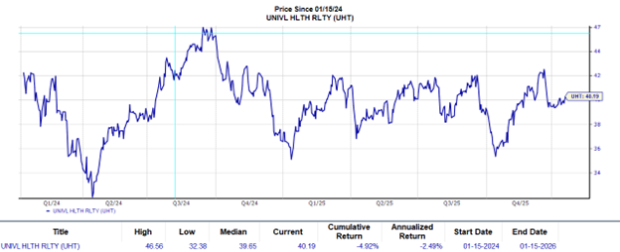
Image Source: Zacks Investment Research
Some investors might be drawn to the less volatile and safer confines of the healthcare industry, especially given the aging population theme.
But the 5-year dividend CAGR for UHT is 1.39%, so perhaps the income might appeal more to short-term income investors looking to clip robust yield while on the sidelines for awhile and not necessarily concerned with annual growth.
Lastly, we profile Oil-Dri Corporation of America (ODC), which is not a REIT. Its products include cat litter, agricultural and horticultural chemical carriers, animal health and nutrition products, fluids purification and filtration bleaching clays, industrial absorbents, and sports field materials.

Image Source: Zacks Investment Research
Oil-Dri Corporation of America (ODC) offers a dividend yield of 1.34%, but the five-year dividend CAGR is around 5%. And importantly, the stock has gained over 200% over the past 5 years, so you might get the added kicker of capital appreciation of the underlying stock. This 5-year stock performance compares to UHT (-42%) and CBL (+43%).
But since ODC is not a REIT, and a growing company, there is always the risk of a dividend cut for capital allocation reasons. But the dividend payout ratio, defined by dividends per share divided by eps, is only 20%, a relatively healthy statistic suggesting lower risk of a cut. In other words, they have adequate cushion from their earnings and cash flow to fund other needs in addition to the dividend.
Regardless, hopefully these examples help investors flesh out their personal risk tolerance profiles and investment time horizons while also re-examining some nuances of investment income.
Zacks Names #1 Semiconductor Stock
This under-the-radar company specializes in semiconductor products that titans like NVIDIA don't build. It's uniquely positioned to take advantage of the next growth stage of this market. And it's just beginning to enter the spotlight, which is exactly where you want to be.
With strong earnings growth and an expanding customer base, it's positioned to feed the rampant demand for Artificial Intelligence, Machine Learning, and Internet of Things. Global semiconductor manufacturing is projected to explode from $452 billion in 2021 to $971 billion by 2028.
See This Stock Now for Free >>Want the latest recommendations from Zacks Investment Research? Today, you can download 7 Best Stocks for the Next 30 Days. Click to get this free report
CBL & Associates Properties, Inc. (CBL): Free Stock Analysis Report
Universal Health Realty Income Trust (UHT): Free Stock Analysis Report
Oil-Dri Corporation Of America (ODC): Free Stock Analysis Report
This article originally published on Zacks Investment Research (zacks.com).
Source Zacks-com


